

A practical spec guide for engineers and project managers sourcing assemblies for DAS, 5G small cell, public safety, and in-building wireless.
Ordering a custom RF jumper assembly sounds straightforward. Pick a cable, pick a connector, pick a length — done. In practice, those three choices branch into a dozen decisions that can mean the difference between an assembly that performs flawlessly at commissioning and one that causes signal issues, fails a PIM test, or simply doesn’t fit the space it was designed for.
Most vendors will build exactly what you order. Few will tell you what you should have ordered. This guide walks through the five specification decisions that matter most — so you can place the right order the first time and avoid costly rework or delays in the field.
RF Industries designs and manufactures RF, fiber, and copper cable assemblies from facilities on both coasts. Everything here reflects the questions our engineering team fields most often from project managers, system integrators, and distributor sales teams who are sourcing assemblies for live deployments.
1. Cable Type — Your Loss Budget Drives This Decision
The cable is the foundation of the assembly, and choosing the wrong type is the most common — and most consequential — mistake. The key variable is attenuation: how much signal is lost per unit length at your operating frequency. Get this wrong and no amount of connector quality or careful installation will recover the dB you’ve left on the table.
Here’s a practical breakdown of the cable types most commonly specified for infrastructure-grade assemblies:
| Cable Type | Best For | Key Characteristics | Watch Out For |
|---|---|---|---|
| LMR-400 | Tower base jumpers, long outdoor runs | Low loss, UV-rated PE jacket, 20-year outdoor life | Stiffer — not ideal for tight indoor routing |
| LMR-240 | Short-to-medium DAS/BDA runs | Good balance of flexibility and loss performance | Higher loss than LMR-400 over distance |
| LMR-195 | Short indoor and outdoor hops, flexible routing | Highly flexible, compact OD | Higher loss than LMR-400 over distance — not suited for long runs or high-power applications |
| Plenum-Rated (UL910) | In-building, above ceiling, return air spaces | Code-required in most commercial buildings | Non-plenum cable will fail inspection — no exceptions |
| Low-PIM Cable | DAS, 5G, carrier-grade systems | Flat braided outer conductor, flex-tested for PIM | Costs more — only spec it where PIM is a real concern |
Pro tip: If your project is in a commercial building, confirm plenum requirements before you order — not after the cable is on site. UL910 plenum rating is a building code requirement in most jurisdictions for cables routed in return air spaces, and it is not negotiable with the inspector.
2. Connector Type — Match the Interface, Not Just the Shape
The connector determines how the assembly mates to your equipment, and choosing by appearance alone is a common path to field problems. Connector families differ in thread type, torque spec, frequency ceiling, PIM performance, and environmental sealing. Getting the wrong one means a cable that either won’t connect at all or will connect incorrectly — potentially damaging equipment.
The connectors you’ll encounter most often in wireless infrastructure:
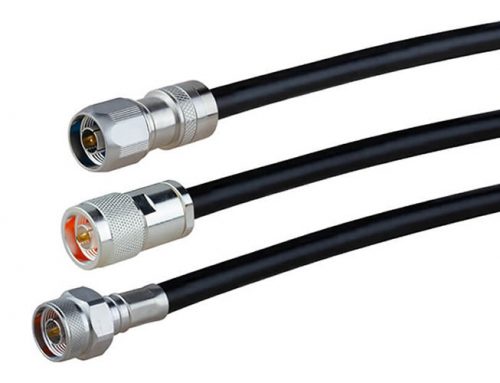
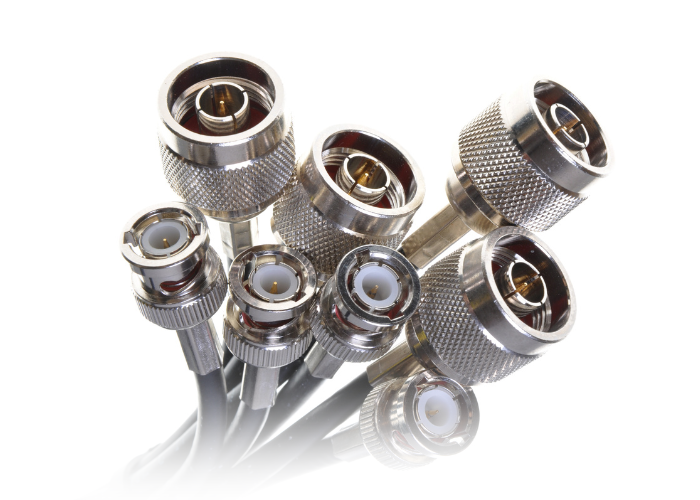
- N-Male / N-Female — The workhorse of wireless infrastructure. Rated to 11 GHz, good power handling, field-proven in tower, DAS, and public safety environments. If the spec sheet doesn’t call out anything else, N-type is usually the right answer.
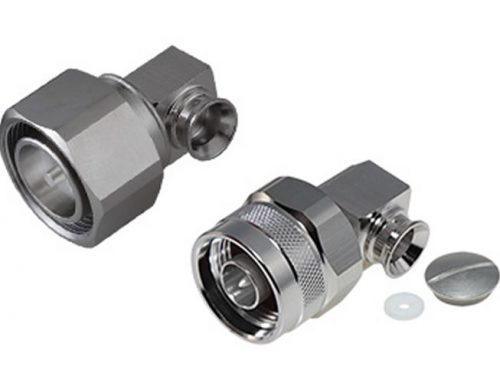
- 4.3-10 — The current standard for low-PIM applications. Physically larger than N-type, with a threaded coupling that resists vibration and delivers better PIM performance. Now the preferred interface on most new DAS and carrier-grade antenna ports.
- DIN 7-16 — High-power, large-format connector for base stations and high-power distributed systems. If you’re working with macro cell infrastructure, you’ll see these.
- SMA — Small, high-frequency connector (DC to 18 GHz) used for lab, test, and short indoor hop applications. Common in CBRS, Wi-Fi, and IoT deployments but not rated for outdoor or high-power use.
- TNC — Threaded version of BNC. Weatherproof, good to 12 GHz
MIXED-CONNECTOR ASSEMBLIES
It’s common — and completely achievable — to have different connector types on each end of the same assembly. An N-Male on one end, a 4.3-10 Female on the other, for example. Specify both ends explicitly when you order. RF Industries builds mixed-connector assemblies to any configuration.
One more thing: confirm gender on both ends before you order. Male and female are not interchangeable, and shipping the wrong gender costs days. It sounds obvious — it happens constantly.
3. Length — To the Inch Is Not an Overstatement
Specifying length seems like the easiest part of the order. It isn’t. The two failure modes are excess and shortage, and both cause real problems in the field.
Too long: excess cable gets coiled or stuffed into tight spaces. Coiling creates impedance discontinuities and mechanical stress at the connector termination. In low-PIM systems, coiled or bent cable can directly degrade PIM performance — a problem that won’t show up until commissioning.
Too short: cable under tension puts mechanical load on the connector body. Over time, this is one of the most reliable ways to cause intermittent connections — and intermittent connections in a live wireless system are extremely difficult to troubleshoot.
RF Industries custom-cuts jumpers to the inch. Order the length your installation actually needs — not the closest standard length that’s close enough.
4. PIM Requirement — Know Your Threshold Before You Spec
Passive Intermodulation (PIM) is the interference generated when two or more high-power signals mix in a passive component — including a cable assembly. In multi-carrier wireless systems, PIM products can fall directly in the receive band and degrade system sensitivity. It’s one of the most expensive problems to diagnose post-installation because it’s invisible until the system is live.
Not every assembly needs a -160 dBc PIM spec. But every assembly installed in a shared-spectrum, multi-carrier, or carrier-grade environment needs some PIM specification — and it needs to be tested, not assumed.
There are two kinds of PIM testing, and the difference matters significantly:
- Static PIM testing — Tests the assembly in a fixed, undisturbed state. Catches obvious failures: poor connector termination, contaminated contact surfaces, material issues. This is the minimum standard.
- Dynamic PIM testing — Tests the assembly under physical stress: bending, flexing, vibration. Catches failures that only appear when the cable moves — which is exactly what happens during installation and over the life of the deployment. An assembly that passes static but fails dynamic is a time bomb.
RF INDUSTRIES: 100% STATIC AND DYNAMIC PIM TESTING — ON EVERY ASSEMBLY
RF Industries performs both static and dynamic PIM tests on all cable assemblies. PIM performance of ≤-155 dBc (≤-160 dBc for 4.3-10 connectors) is guaranteed. Testing is conducted using Kaelus equipment with two +43 dBm carriers. Every assembly meets ISO 9001:2015 and IPC/WHMA-A-620E standards.
PIM Tracker™: On-Demand Test Data for Every Assembly
Every RF Industries cable assembly ships with a serial number printed on the cable jacket. That serial number links directly to the PIM Tracker™ — an online tool that gives you instant access to the test parameters and verified PIM performance data for that specific assembly, from anywhere, at any time.
This matters for your customer. When a carrier or building owner asks for test documentation at commissioning, you have it. When an assembly is questioned in the field weeks after installation, you can pull the original test record. PIM Tracker™ provides the paper trail that professional wireless deployments increasingly require.
Test results can be delivered in multiple formats: printed, emailed, uploaded to Dropbox or flash drive, or accessed online via the serial number at any time after shipment.
Ready to Build? Here’s How to Start.
RF Industries designs and manufactures RF, fiber, and copper cable assemblies from state-of-the-art facilities on both coasts. With 30+ years of experience and in-stock components for fast turnaround, we build to your exact specifications — custom length, custom connectors, custom labels, custom kits.
Every assembly is 100% tested for static and dynamic PIM performance and sweep tested for S11 and S21 parameters before it ships. ISO 9001:2015 certified across all facilities.